For landlords
Information for landlords
We act for tenants. That doesn’t make this site off-limits to you — most of what we publish is simply what the law now says, and a landlord who knows it is a landlord who doesn’t end up here as a respondent.
The guide, the step-by-step and the questions pages are free, and we’re content for landlords and agents to read them. Rent Repayment Orders are entirely avoidable: they often follow from letting without a licence you needed, or from evicting or harassing someone. Nothing on this page is legal advice on your own position.
Start with the guide
It’s written for tenants, so it reads from the other side of the table — which is exactly why it’s useful. It sets out the ten offences, the two regimes created by the Renters’ Rights Act, how tribunals now assess the amount, and the defences that actually work.
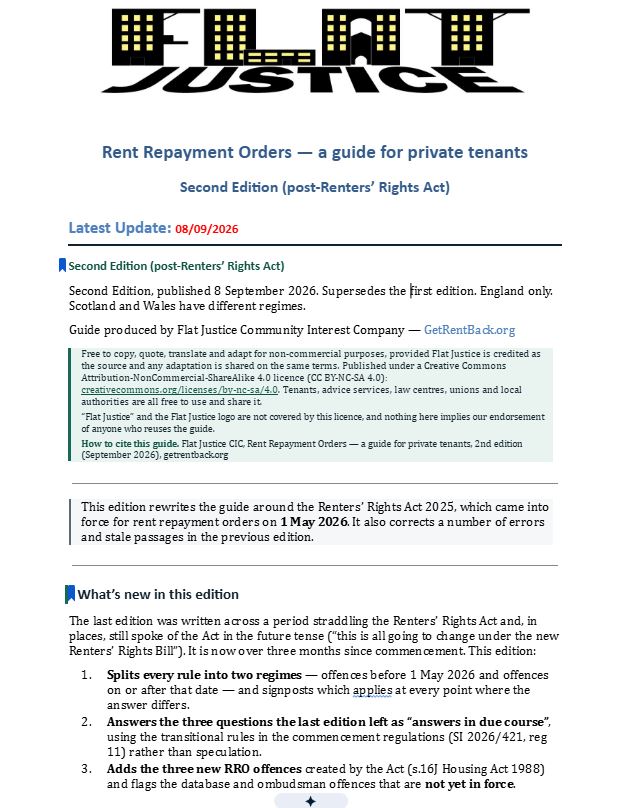
Rent Repayment Orders — a guide for private tenants
Second edition, September 2026 · rewritten for the Renters’ Rights Act
Free to copy, quote and adapt for non-commercial purposes under a CC BY-NC-SA 4.0 licence, so you may use it in your own training as long as Flat Justice is credited and any adaptation is shared on the same terms. Our name and logo are not covered by the licence, and using the guide does not imply our endorsement.
Where to get trained
Landlord training and accreditation in England is voluntary. There’s no licence to be a landlord and no qualification you must hold. What follows is a starting point, not an endorsement — we have no connection with any of these organisations and take nothing from them. Checked September 2026; check the price and the dates yourself before booking.
Open to landlords anywhere in England
- NRLA Training Academy The National Residential Landlords Association’s courses on tenancies, repairs, safety, standards and tax, online or in a classroom. Paid, and open to non-members. Its separate accreditation scheme requires full membership.
- London Landlord Accreditation Scheme Run by Camden and used across and beyond London. A one-day development course plus a code of conduct and a fit-and-proper test; you pay for the course, not for membership. Several councils discount licence fees for accredited landlords.
- Accreditation Network UK — schemes near you A free directory of landlord accreditation schemes by region. The quickest way to find whatever operates in your area.
- Unipol landlord training events A charity working in Leeds, Bradford and Nottingham. Free training events, and the Unipol Code for student landlords. Worth a look if you let to students anywhere.
- DASH Services Midlands-based but open more widely. Paid courses, several written specifically for the post-1 May 2026 rules, plus a free Renters’ Rights course and its own accreditation scheme.
Councils that train their own landlords
Many councils run or fund training, and some tie it to a discount on licence fees. A few current examples, geographically spread — if your own council isn’t here, search its site for “landlord training” or “landlord forum”.
- City of York Council Council-run courses online and in person, free to current HMO licence holders and paid for everyone else. Dates published well ahead.
- Portsmouth City Council Landlord Accreditation Scheme Its own accreditation scheme, with free landlord training events listed as a benefit of joining.
- London Borough of Redbridge Signposts the main schemes and gives a discount on each property licence application once you have completed an accreditation course.
- London Borough of Waltham Forest Routes landlords to the London scheme and explains what accreditation involves.
- Nottingham City Council — the Nottingham Standard A council-backed mark bringing two schemes together: an online course, a code of conduct, a fit-and-proper test and a property inspection.
- Greater Manchester Good Landlord Charter Free and voluntary, covering all ten Greater Manchester boroughs, with support from a dedicated implementation unit.
Free official guidance
- Assured periodic tenancies: a guide for landlords The current government guide, and the one that matters most since 1 May 2026: every assured shorthold tenancy became an assured periodic tenancy on that date. It replaced “How to let”, which has been withdrawn.
- House in multiple occupation licence When a licence is required, what conditions come with it, and the penalties for letting without one.
- Implementing the Renters’ Rights Act 2025: the roadmap The official timetable, including the private rented sector database and the landlord ombudsman.
Two duties still ahead of you. The Renters’ Rights Act creates a private rented sector database that landlords will have to register with, and an ombudsman scheme landlords will have to join. On the government’s published roadmap neither is open yet — database rollout is expected to begin from late 2026, and the ombudsman later still. Commercial sites are already selling “registration” help for a database that doesn’t yet accept registrations.
Facing an RRO application?
An application has landed. What follows isn’t advice on your case — get your own — but these are the mistakes we see respondents make over and over, from the other side of the file.
Not taking advice, or leaving it too late
An RRO is a legal claim, often for a five-figure sum, decided by a specialist tribunal on documents you’ll not get a second chance to file. People who represent themselves on the strength of a forum post generally lose points they didn’t need to lose. If the sum at stake is more than a solicitor’s fee, that arithmetic answers itself.
Ignoring the tribunal’s directions
Directions set dates for statements of case, bundles and witness statements. They are orders, not suggestions. Missing them can mean being barred from taking part, or being unable to rely on the evidence you left out — and a tribunal that has had to chase you notices.
Harassing the applicant, or trying to evict them
This is the single most expensive mistake on the list. Retaliating against a tenant who has applied doesn’t stop the application; it adds to it. Conduct is one of the matters the tribunal must take into account in fixing the amount, and it’s the most common reason an award goes to the top of the range instead of the middle. It can also be a criminal offence in its own right, and illegal eviction and harassment are themselves grounds for a further order.
Assuming the licence application fixed it
Applying for a licence stops the offence continuing from the date the application was duly made. It doesn’t undo the months before that, which are still claimable. Nor does an entry on the council’s register prove when the application was made — the date the council received a complete, duly made application is what counts.
Arguing there was no licensing scheme when there was
Additional and selective schemes are made borough by borough, come and go on five-year cycles, and are easy to miss if you bought or inherited the property mid-scheme. Check what applied on the dates in question, not what applies today.
Blaming the agent
Using an agent doesn’t transfer the duty to hold a licence. It may be relevant to whether you have a reasonable excuse, and it may give you a claim against the agent. But this is only in cases where there was a clear management contract under which the agency had a duty to license the property.
Putting nothing before the tribunal on the amount
Even a respondent who is plainly liable can affect what is ordered. The tribunal must consider the conduct of both parties, your financial circumstances and whether you have been convicted. Evidence about all three has to be filed — asserting it at the hearing is too late. What doesn’t work is arguing about your mortgage or your outgoings as though the award were a profit calculation.
Refusing to talk
A large proportion of RRO claims settle. Settling costs less than losing, ends the matter privately, drastically reduces any legal charges and avoids a published decision with your name on it. It’s worth at least finding out what the other side would accept.
Apply now. Every week without a duly made application is another week of the offence and another week of rent in the claim — and, more to the point, an unlicensed property has usually never been inspected. If there’s a real safety problem, deal with that first.
Contacting us
We act for tenants and cannot advise you, so we’ll not answer questions about your own case or negotiate with you except through the applicant. If you’re the respondent in a case we’re running and want to discuss settlement, write to us and we’ll pass it on.