Make a claim
What an RRO application actually involves
An honest account, written for people deciding whether to start. How long it takes, what you’ll have to do, what it costs, what you’re likely to get, and the reasons we sometimes tell people not to bother.
The short version
You’re asking a tribunal to order your landlord to repay rent because they committed a criminal offence. You have to prove that offence to the criminal standard — beyond reasonable doubt. In a licensing case that’s usually straightforward, because the council’s records either show a licence or they don’t.
It’s a paperwork exercise, not a courtroom drama. Most of the work is assembling documents and writing clearly. Hearings are normally in person and usually take half a day or less. Most applicants never speak to a lawyer.
How long it takes, and how much of your time
The tribunal’s own rhythm is at least three months from application to hearing, with the decision following one to six weeks later. In practice, allow four to six months from applying to holding a decision: listing takes longer than the minimum, a case management hearing adds a few weeks, and directions slip. An appeal, if there’s one, adds months.
Your effort isn’t spread evenly. It arrives in three lumps:
- Before you apply — gathering rent evidence, getting the council’s licensing confirmation, working out the offence dates, checking who your landlord actually is. Half a day to two days.
- Your bundle — the statement of case, your witness statement, indexing and paginating. A day or two.
- The reply and the hearing — reading their bundle, answering it, preparing to be asked questions. A day, plus the hearing itself and the travel to it.
In between there are long quiet stretches where nothing happens and you wait for a letter.
What you’ll have to dig out
Always
- Proof you paid rent — a bank search, ideally as a PDF
- Your tenancy or licence agreement
- The council’s written answer on the licensing position, the dates, and whether and when an application was duly made — not a register screenshot
- The registered title, to establish ownership
- The dates you lived there
For an HMO
- Who else lived there, in which rooms, and when
- Which facilities were shared
- Photographs of the layout if occupancy is disputed
- Messages or group chats establishing who was there
If your landlord disputes occupancy or the offence dates, the case depends on this material. It’s much easier to collect while you still live there, or shortly after you leave, than a year later.
What people actually get
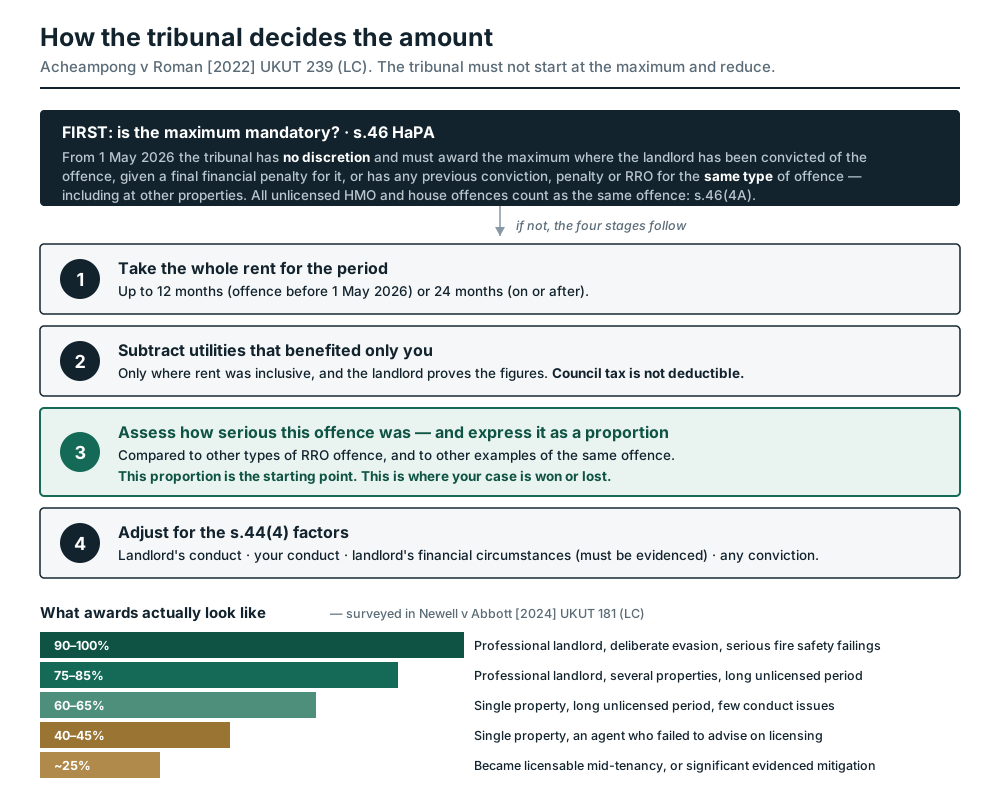
The tribunal doesn’t start at 100% and take deductions off. It works out the whole rent for the period, removes any element that was really payment for utilities you consumed, decides how serious this offence was as a proportion of the rent, and then adjusts for conduct and the landlord’s finances. The maximum is reserved for the most serious cases.
| Band | Typical scenario | Where it comes from |
|---|---|---|
| 90–100% | The most serious: professional landlord, deliberate evasion, serious fire safety or condition failings; illegal eviction by force or lock-change. Rare, but achievable. | Aytan v Moore 85%; Wilson v Arrow 90% [2022] UKUT 27 (LC) |
| 75–85% | Professional landlord with several let properties, unlicensed for two years or more. | Choudhury v Razak 75%, with Acheampong v Roman [2022] UKUT 239 (LC); Simpson House 3 Ltd v Osserman 80% [2022] UKUT 164 (LC) |
| 60–65% | Non-professional, single property, long unlicensed period, few or no conduct issues. | Hancher v David 65% [2022] UKUT 277 (LC); Newell v Abbott & Okrojek 80% reduced to 60% [2024] UKUT 181 (LC) |
| 45% | Owner of a small portfolio, one of the properties an HMO. | Dowd v Martins [2022] UKUT 249 (LC), discussed at Newell ¶53 |
| 25% | The property became licensable part-way through the tenancy; or a first-time landlord not alerted by their letting agent to the need for a licence. Mitigation isn’t the same as a reasonable excuse. | Hallett v Parker — £3,000 of £11,712.75 [2022] UKUT 165 (LC) |
| under 10% | Genuine, evidenced hardship — precarious finances and serious illness. | Daff v Gyalui & Aiach-Kohen — £2,000, “very much towards the bottom of the range” [2023] UKUT 134 (LC) |
The leading survey of where awards fall is Newell v Abbott & Okrojek [2024] UKUT 181 (LC), at ¶¶47–57 with the taxonomy at ¶57. The tribunal must assess how serious this offence was against other offences in the table and against other examples of the same offence — not start at the maximum and discount.
A landlord with a properly evidenced hardship case can bring an award below 10%. Knowing that before you start is better than discovering it at the hearing.
If your landlord has been convicted of, or finally penalised for, the same offence — at any property, at any time — the tribunal must award the maximum for offences on or after 1 May 2026. Ask the council about civil penalties before you plead the amount.
Settlement. Many cases settle. Aim slightly below the band you would expect at a hearing, and take into account that a settlement is certain and a hearing isn’t — and that payment is also certain and immediate, where an award may still have to be enforced.
The hard parts
Your landlord will say things about you that aren’t true
Expect to be described as a difficult tenant. Some of it will be irrelevant to the offence, and you can ask the tribunal to disregard it. Some may be relevant — rent arrears, for instance, have been held capable of counting even without a direct link to the offence. Be candid about anything real. Candour buys credibility for everything else you say.
They will plead poverty
The landlord’s financial circumstances are a proper consideration, and tribunals have reduced awards on thin material. Push for it to be properly evidenced — recent tax returns and evidence of expenditure — rather than an account given from the witness box.
You have to prove a criminal offence
Beyond reasonable doubt. In a licensing case the council’s records usually do the work. In a harassment case they very often don’t, which is why harassment-only claims are hard to win.
It’s your responsibility to stay on top of all the deadlines
Miss a direction and you can lose. Diarise every date the tribunal gives you the day you get it.
When not to apply
The amount the tribunal can order for a period is the rent paid by or on behalf of you, less any relevant award of universal credit paid to anyone in respect of rent under the tenancy for that period. Where housing benefit met the rent instead, that part is recoverable only by the local authority, and only if the authority applies.
So if your rent was met in full by the housing element throughout, your own recovery may be nil, however serious the offence. Work this out before anything else — it’s the first thing we check.
- A respondent with no assets. An unenforceable award is worth nothing. This was the killer objection in rent-to-rent cases — but for offences on or after 1 May 2026 you can now name the superior landlord and the company officers, so re-run the analysis before writing a case off.
- Not enough evidence. A weak case fails, and the standard of proof is high.
- The landlord is bankrupt, in liquidation or in prison. There’s no point winning against someone who cannot pay.
- Harassment only. Many tenants feel harassed; harassment as an offence is much narrower, and a tribunal with a reasonable doubt makes no award.
- They may have a genuine excuse. Every landlord thinks they have one; some do.
If you still live there
Please don’t stay put in an unlicensed property on the basis that you’ll deal with it later. Unlicensed properties are, by definition, ones the council has never inspected, and they are where the serious hazards are found — fire doors, escape routes, electrics, overcrowding.
An RRO application almost always prompts the landlord to apply for a licence. That brings the council in, and most unlicensed properties turn out to need works before a licence can be granted. Making the application is one of the more reliable ways of getting your home made safe.
If you’re worried about your immediate safety, contact your council’s private sector housing team now, without waiting for anything on this site.
Being a sitting tenant changes the tactics, but far less than it used to. Section 21 — the no-fault eviction notice — was abolished on 1 May 2026, and existing assured shorthold tenancies converted. Your landlord can no longer evict you simply for making an application. They must rely on a stated ground, and if they knowingly or recklessly misuse one of the new possession grounds, that’s itself an offence you can bring a further Rent Repayment Order for.
The exception is a resident landlord. If you share a kitchen, bathroom or living room with the person who lets to you, your security is limited and the letting may be outside selective licensing. But don’t assume the claim is dead: under mandatory licensing the landlord and their household count towards the five, and a self-contained flat let by a landlord living in another flat in the same house shares no amenity and isn’t exempt at all.
Doing it yourself, or asking us
Do it yourself
Best if your case is straightforward: a clear licensing gap, a solvent named landlord, good rent records, and you’re comfortable writing a structured document and being asked questions. You keep 100% of the award, and our guide and advice are free.
Ask us to run it
Best if there’s a company or a rent-to-rent chain involved, several applicants, a straddling offence, a disputed occupancy, or the landlord has already instructed solicitors. We pay the fees, do the work, and charge 20% of what is recovered. Free advice on enforcement afterwards if the award goes unpaid.